Indigenous Education System: Symbol of Mundumic Suptulung Narrate Education System of Kirat Rai
Adv. Shanti Devi Rai, (PhD), Lalitpur
Scholar of the Mundum, culture, and language of the Kirat Rai community.
Introduction
From the beginning of the time when humankind came into existence, humans have been developing skills and beliefs to support their living. Similarly, Kirat Rai people develop Suptulung as the center point of the belief. Through this belief they survive with distinctly in the world as well as nature. Due to Mundumic Suptulung they have district educational practice. They have been forming and developing societies and finding ways to continue of the legacy of a social human life.
Everything the humankind discovered in relation to the skills, beliefs and creations have been implemented in our lifestyle in the present day and this knowledge has been defined as a part of indigenous education. The knowledge that was carried by the ancestors of the indigenous people have been improved and transformed, knowledge of how to survive and of beliefs have now been defined as an important knowledge by the philosopher.
The education of the world has been classified into two forms; formal and informal education. Indigenous educations are considered as an informal and marginalized education. In the context of Nepal, Constitution of Nepal 2015, it is written that the group of people that are socially and culturally backward are the indigenous group of people and the government has given importance to preserving their knowledge and taking care of the important things relating to the community.
As said by Cajete (2004), indigenous people are able to develop skills with the help of the elements of the nature and by being together with the nature. It is a skill of the indigenous people to be able to reform and transform the knowledge and skills of their community alongside nature. Indigenous knowledge is a skill that has been developed through experiences and nature.
All the activities that happen all around the world are passed down knowledge from the ancestors, their skills and tactics of survival become knowledge that people all around the world use in their daily lifestyle, all of them are the legacy of the ancestors. And this legacy has now become the holistic education of the indigenous people.
According to Diabetes (2020), there are 5000 distinct cultural community group with their own different language and religion.
In the context of the Nepal the National Foundation for the Development of the Indigenous Nationalities Act 2002 said that there are the 59 indigenous group in between the one of the sub group is the Kirat Rai community. According to census of the 2011, the population of the Kirat Rai people is 807,169 in total. In the population of the Nepal and in terms of religion, it is in the fourth group. Their territory is the eastern part of Nepal, i.e., Province one. Far before the name of the region was Khambuwan, Limbuwan and Koichwan. Similarly, Pallo Kirat, Majh Kirat and Pallo Kirat are the names of places where Kirat people reside and it is uniformly called the Kirat Prades.
Prophesy is that the base of Mundumic education is the Suptulung. The Mundum is the Holy Scripture and the Suptulung is the holy place (Rai, 2020). They have distinct knowledge in farming, animal husbandry, plant domestication, plant medicine, healing, and clothing (Diabetes, 2020) woodcraft jointly astronomy and biology. There is transformation in this knowledge through oral tradition, storytelling, myth, legends, and proverbs and with the cultural performance.
According to the Constitution of Nepal 2015, Mundum philosophy and the Suptulung education is the informal education and is marginalized and backward education. Indigenous people’s knowledge, education is protected by the international law. Constitution of the Kingdom of Nepal 1990 has stated in the primary section that every child can choose to get education in their mother language, but the implementation of this law is not satisfactory. The reason behind is the formal education curriculum on optional subjects.
Marchant (2009) said that the own worldview should be understood by self then only can they be able to teach their own children. There are some religious schools such as Gurukul, Gumba and Madarsa these all run by the surveillance of the Nepal government as a formal education system. Mundum philosophical education can also be taught as a formal education. Mundum has its own philosophy, and educational policy in the oral tradition.
Because of the wide practice of formal education, Mundum and Suptulung are in danger. Limited people know about the value of Mundum and Suptulung. Mundum philosophy is linked with the nature and environmental education. The Suptulung education refer to practical education in field. The role of teacher would be facilitators. Education must be the used to promote better life, and must be the voluntarily insight of the Mundum.
Mundum states that knowledge lies in natural land, in plants and trees, in rivers and oceans and any form of water and in birth and death. Without mental, emotional and physical pressure, the exiting knowledge of the value of life is the base of indigenous education (Jacob, Cheng, & Porter, 2015).
Indigenous education has focused on the food security, inhabitant and good relationship with the environment. Kirat Rai people have been continuously been using Mundumic philosophy and practiced its knowledge in their livelihood.
The objective of this study is to explore and the expose the obligation of teacher (Mangpa/Nachhung and Risimi) in the philosophy of Mundumic education. Indigenous education takes Mangpa/Nachhung, Rishimi, Ngabucho, Nakso, Nachhung, Kharumi, Chapsami, Suruli, Kubi, Dowang, Dowa, Pasing, Masimg, Fedangba and the ritual experienced elderly as a teacher.
Literature Review
Indigenous education is the gathered knowledge of the teachings of ancestors (Ermine, Battiste, & Barman, 1995) that is holistic and spiritual. Indigenous knowledge is the correlation of human and nature. Indigenous people are very close with nature, adapt with it, and take it as a part of their life. The experience of the nature is the experience of the ancestors (Warren, 1991) and is the indigenous knowledge and indigenous education. The skill of transformation method of indigenous knowledge is the indigenous education.
Indigenous people respect to the ancestor and the knowledge of ancestors. Human experience are an ocean of knowledge that serve by the cultural activities (Cajete, 2004). The experience of picture drowning out through the thousands of people passing thousands of years. Fables, myth, legends, and proverbs are the element of the indigenous educational knowledge (Omolewa, 2007).
The knowledge and education of the indigenous people and indigenous community is not forced upon learners and the people of the community. As an informal learning process, education is a see and do process, there is no mental or physical pressure put upon anyone to find their place in an indigenous community. The rituals and the activities of major events have their own simple process and it is believed that one can learn by watching.
Songs and stories are important mediums of gaining knowledge about the community. Songs and stories are important because they contribute to the continuity of the indigenous communities (Burnard, Dillon, Rusinek, & Saether, 2008). Indigenous education is a holistic education that helps is the mental development of children (Absolon, 2010). Indigenous education is a subjective education and has flexible approach, because it is based on indigenous knowledge, anyone learning can have his or her own personal perspective towards the education.
Indigenous education is a lifelong education (Battiste, 2014). The experiences of life from birth to death is indigenous knowledge (Jacob et al., 2015). Indigenous education is framed through specific communities, land structure and culture (Morcom, 2017) where people are involved in practical activities for learning. This is a holistic education. Indigenous education is implemented spiritually (Rai, 2020).
Indigenous education is the reflection of the life of humankind. It is started with the connection of dirt and soil. Indigenous education is the education about the relation and connection of nature and human life. Suptulung education is based on nature and natural life. Life is nature (Rai, 2020). All things that we have and all things that exist is given by nature in the absence of nature there will be nothing in the universe.
Methodology
This study is based on interpretivism. Wilson (2001) said that he did data analysis and analysis to complete the purpose of his research study. I have collected data as guided by (Lincoln & Guba, 2000). I have used the storytelling method (Kovach, 2010) for collecting data because the Mundumic philosophy is traditionally based on oral tradition.
With the purposive sampling (Etikan, Musa, & Alkassim, 2016) method, samplings have been chosen. Data collection was done in province 1, Sakela rural municipality and Pachthar’s Yangwarak rural municipality. In the process of data collection, permission was taken from the stakeholder by giving priority to ethical values. All data were primary data.
According to the census of 2011, among the 26 subgroups of the Kirat Rai community, the Sakela and Sypuiya of Chamling Rai community and yeast making method were adopted for data collection.
Findings
Among the 32 generations where Kirat reign existed, the Kirat Rai people believed Mundum as a philosophy and Suptulung as a center of discipline. Suptulung is the center of education and holy place for the Kirat Rai people (Rai, 2020). The ancestors have fundamentally transmitted their knowledge and skills to their younger generations. Through traditional and cultural methods (rituals and events), they have been passing down their knowledge of way of lifestyle for their younger generations.
The complete education of the Suptulung is centered on land. The Kirat Rai people believe the earth as mother Sumnima/Naima, and the sky as father Paruhang. They believe themselves as the children of these ancestors; the earth and the sky. The Kirat Rai people consider the knowledge left by their ancestors as a valuable property, the only way to increase this treasure is by sharing them. The knowledge left by their ancestors continues to be the part of Kirat Rai people.
In the following section, I present the findings pertaining to philosophical and educational system of Mundum.
Philosophical Educational System and Science related to Mundum
Kirat Rai people have their own calendar, according to present existing year, the first full moon of the Baisakh month is the day when Sopuiya is done. The purpose of Sopuiya is for good cultivation, for good soil for farming and for the overall improvement in the environment so that it is suitable for the beginning of agriculture.
Sopuiya is a ritual where Mundum is done to all the misfortunes that are to occur in the year and flown away in the near river. The day of the full moon, all the Rai’s are all gathered in the house of the main Rai and in the front yard of the house, Rai’s gather to witness the ritual. The Mangpa/Nachhung begins the ritual by chanting and calling the ancestors and communicating spiritually. With respect, the Mangpa/Nachhung puts forward the concerns of the people of the village.
The main elements required in this ritual are ginger, banana leaf, rhizome, rice and yeast that is used in making alcohol and millet alcohol. This day is also called Ubhauli Purne (the eve of Ubhauli) and the Kirat Rai people call is Dhiriyamlo and or Dhirinam. The process of venerating is done in mother tongue. For this ritual process, all the heads of the different households are required to bring their own share of rice, ginger and alcohol.
The ginger plays an important role. When the rhizome is cut in the name of the family, how it lands determines the good and bad in the future of the family. When the cut rhizome lands on the bad, more chanting and singing is done to the ancestors. Through Mundum, all the agricultural lands, rivers, canals and the environment are purified. This is done by the Mangpa/Nachhung and Risimi by saying “Let the canals be filled with water and the soil be loose so the agriculture can be successful, let all the taps and ponds be filled with water”; repeatedly.
As agriculture and cultivation is not possible in the absence of water, all the Kirat Rai people gather and along with Mangpa/Nachhung and Risimi, pray to the ancestors and ask for their blessings. When the migratory birds (Karyang kurung) fly over to the hills, the people understand that it is time to start their agriculture.
The ritual of Sopuiya is done to prevent any misfortune from occurring. The Kirat people ask their ancestors for forgiveness if in case they had done any wrong to the earth. Sopuiya is also done with the belief that when digging the earth for agriculture, the earth might feel pain. They ask for forgiveness beforehand in the ritual of Sopuiya.
After the ritual, the Mangpa/Nachhung and Risimi people of the community visit every household with people carrying Kirati drums (dhol) and jhyamta. For the day of Syopaiya, this continues until the fourth day after the ritual event.
When asked the purpose of Syopaiya, “If Syopaiya is not done then it is considered an insult to all the contribution and knowledge of the ancestors that they left to us. We have to do it no matter what because it is for the good of everyone.” was said in the interview.
Spiritual belief, spiritual power is very strong and unbreakable in indigenous communities. Spiritual satisfaction is the best medicine for peace, happiness and a happy life. Cultural activities are an important medium to learn and carry-on tradition from generation to generation. Sopuiya is a medium of connecting with and understanding nature. Belief is developed between nature and the ancestors of the indigenous community through the medium of Sopuiya.
Sakela
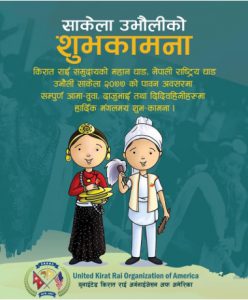
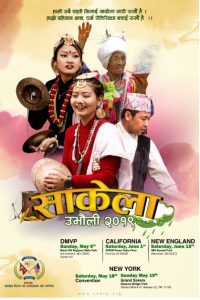
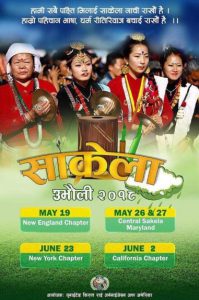
Sakela is the day when the prayers and requests of Syopaiya is answered. In the early morning of the day of Sakela, the Mangpa/Nachhung and Risimi people of the community gather and take a small hazelnut tree and put it at the center of the front yard and start the ritual with paddy, a maize plant along with bajra alcohol, rice and ginger. In the ritual they venerate with Kirati drums (Baradhyola, dhol) and Cymbals (Chhamakhi).
The people then gather around the tree and in a circle, they perform silli (Dance step) which is the traditional dance of the Kirat Rai community. In this dance, they mimic different birds and animals and coordinate their steps. The silimagpa ones who guide this dance ritual, they control the movements and the rest follow. People of all age groups are welcomed to take part in it. This dance is a symbol of togetherness, respect and love for each other in the Kirat Rai community.
Indigenous education is all about correlation between the living beings of the earth and the nature. Sakela is the event where people come together and celebrate with the hope of proper agriculture and with hope of enough food for all year round.
In the indigenous community, the main concern is which plant will grow well this year and what kind of farming will bring positive results. They are worried about scarcity of food and about epidemics. It is believed that on the day of Sakela, the Mangpa/Nachhung and Risimi is given signals by the ancestors about what kind of plants and crops will flourish in the agricultural fields. This is all a form of spiritual belief and everyone takes it as a form of education and do their farming.
The people of the community work hard and move forward with a hope for enough crops for the whole year and that no pests affect their harvest. As Mundum is based on nature, all people who follow the Mundum believe in nature. This activity is done every year. All participants of this ritual are fully invested in the activity and take it as a form of education. Songs, stories and sayings also play an important role in contributing to traditional beliefs.
According to Mundum, the Kirat Rai women of the Kirat community are well skilled in making Khabai/Babkha (Yeast used in making alcohol). According to Mundum Naima and Numnima were the ancestors who first started making Khabai/Babkha. Initially it was made for food for Risimi which is why it is not known for men to make it. Stories say that only women made Khabai/Babkha and were good at it.
There is a tradition that only women who are in menopause make the Khabai/Babkha and if young girls who are yet to get their menstruation end up making a Khabai/Babkha, they can continue to make them. Specifically while making Khabai/Babkha, wathengma (a herb plant), chitu, Kharsi (walnut)t, malakhudo (a climbers plant), Walle chachhung (Pan), Khabaisung (Samml Bhimsenpati), etc. are used in making Khabai/Babkha.
Traditionally any of these herbs are mixed in rice flour and bajra flour and made into Khabai/Babkha. While making Marcha, a bigger ball of it is made as the mother. Every time when Khabai/Babkha is made the bigger ball of Khabai/Babkha which is considered as the mother is surrounded by the smaller Khabai/Babkha which can be used immediately. The mother Khabai/Babkha is used on the next lot and replaced by a fresh ball of mother Khabai/Babkha. The older Khabai/Babkha is mixed with the new batch. This process contributes to the fermentation of the Khabai/Babkha.
When a batch of Khabai/Babkha is made, a little bit of chilly and coal is put on top of each of them. This is done to prevent bad energy and bad spirits from touching them. The process of storing this Khabai/Babkha is by placing them on freshly cut fern and on a top shelf above the traditional stove that is made of mud. This is to ensure that the heat helps the fermentation of the Khabai/Babkha. This is a method that is believed to have been used by Sumnima.
Khabai/Babkha has many uses but it is mainly connected to Sumnima. It is a product of native science that is made with the infusion of various herbs. When Khabai/Babkha is cooked and prepared in a specific way, it becomes an alcoholic beverage called Umma(Alchohal, Jaad). In every Mundumic ritual, Umma is an important element. Without Umma, a ritual is incomplete.
According to Mundum, Umma is required to be made twice a year. Because of the fear of epidemic and starvation, the container used to store Umma is sealed shut with a dry banana leaf or leaf of Saal and coal. If there is no Umma in a household it is not considered a good sign. Every Mundumic ritual of a household requires Umma, therefore a house should never run out of it.
Khabai/babkha is also used for medicinal purposes. It is used to treat a fungal disease called pillow. The Umma made by Khabai/Babkha is also known to be very good for health. Traditional alcohol is also believed to help with sore body and when ankles are twisted. Umma has a very important role in Mundumic practices and indigenous people have continued the production of Umma and Khabai/Babkha from a very long time.
Discussion
In order to live, humankind developed various methods to be able to continue their lifestyle. There was a development in their way of living as time continued. As a result, these methods of living and surviving became a form of indigenous education. More than formal education, indigenous people valued the knowledge that helped them survive and the knowledge that were passed down from generation to generation. Their bond is in their shared knowledge.
The indigenous people strive to live a righteous and simple life and they pass down their knowledge on the way of living a good life to their coming generations. Warren (1991) said that indigenous knowledge is the long and absolute experiences of their ancestors. The sacrifices and knowledge of the ancestors are now the base of indigenous education.
Tuhiwai (1999) said that the nation made the indigenous people indigenous, and their knowledge, education and culture should be protected and they must be provided guarantee of their identity, language and culture because they want to live the way they have always lived with their original identity. The indigenous people want to take care of their jungles, villages and nature with their own authority. The virtues of Sopuiya also supports these claims of the indigenous people. The main purpose of Sopuiya is the protect and nurture the nature and with their own authority, the indigenous people can protect their culture and tradition.
Nature is a big part of the lifestyle of the indigenous people and the government must protect and contribute to the conservation of nature for the indigenous people because indigenous people were made indigenous by the nation itself.
The purpose of Sakela is the aware, prevent and control any mishaps from happening as warned by the spirits of the ancestors. Khabai/Babkha is used in both the events of Sopuiya and Sakela. Khabai/Babkha is important for a Kirat Rai ritual because its purpose holds spiritual beliefs. It’s presence in rituals has a continuity from the time of their ancestors. The ancestors have spiritual connection to it. In the presence of Umma and Khabai/Babkha it is possible for ancestral spirits to know their children.
Mangpa/Nachhungs and Risimi play an important role in transferring this knowledge to the younger generations as Mangpa/Nachhungs and Risimis are the bridge that connects the spirits of the ancestors and the present generation in a way found that are Moral education, corrective education and societal education.
Moral Education in Mundum Philosophy
In indigenous education, the experienced Risimi and Mangpa/Nachhungs are the root of guidance to the people of the Kirat Rai community. As they highlighted, they advise the people of the community to live a good life through traditional values or through stories, myths and songs. It is important to keep balance in the community. The Mangpa/Nachhung and Risimi communicate with the spirits of ancestors, relay their values to the people of the community.
Many philosophers have said that spirituality leads to a moral lifestyle. Solomchenko, Gorbacheva, Sorokina, Uchasov, and Boyko (2019) said that spirituality helps create balance in nature and society. Milner, Crawford, Edgley, Hare-Duke, and Slade (2020) added that spirituality makes an individual optimistic and have positive values. Spirituality is a way of healing. Absolon (2010) said that believing in our ancestors, we become mentally confident.
The result suggested that, in the event of Sakela and Sopuiya, the gathered people express their own emotions and experiences in a spiritual way. They share their experiences. This action of sharing is a form of togetherness and the love they have for each other. In the gathering, the conclusion came to everyone’s concern being the same. Everyone worried whether there would be a scarcity of water, if the rivers, canals and ponds were clean and had enough water and if the soil was good for agriculture. Everyone’s main concern was water and in his or her mind, they were worriedly hoping towards their ancestors for their help in this matter.
These concerns are more practical in indigenous communities. In indigenous communities, these types of concerns are discussed and the solutions to the problems are put into practice immediately. When an individual witnesses a problem, they are more likely to find the solution. Knowledge that is gained from books and knowledge that is gained from experience has different impacts.
From the result, it is clear that, with practical education, an individual creates his or her own insight on how a problem can be fixed. Contributing to an issue makes them mentally strong and confident. The opinions formed through experience help build optimism. Having belief towards one’s ancestors can help them live a good life as with belief comes with trust and he or her believes the morals and virtues of his or her ancestors and practices them in their daily life.
By listening to their ancestors, they are closer with nature. With optimism, one will always take side with the right instead of the wrong. They will help the one in need and do justice to everyone. In indigenous communities, songs, myth, legend, proverbs and stories play important role in developing the mindset of the people in the community.
Corrective Education in Mundum Philosophy
The purpose of doing Sakela and Syopuiya every year is to continue the flow of the usage of old methods. Behroozi and Karimnia (2017) said that positive education contributes to the corrective usage of old methods. The result suggested that, corrective education helps to encourage the stakeholders with change in time and when in need.
Hamilton-Ekeke and Dorgu (2015) said that indigenous education is correlated with nature. Marsden (2006) said that indigenous knowledge is a generational knowledge, which is passed down with time from generation to generation. In this process, various changes and reforms occur in between.
During Sakela and Syopaiya, along with practicing the continuity of tradition, the elderly people of the community gather to discuss the peace of the community and what else can be done for the betterment of everyone in the community. They discuss the matters of the community and respectively put responsibilities on each other in order to practice peace in the community.
Yoon (1997) state that corrective education brings change in the mentality of an individual and in their way of life and how they do certain activities. Sakela and Sopuiya hugely affect the yearly activities of Kirat Rai people. It is not only a day of celebration and ritual but also a day where the ancestors guide their children through Mangpa/Nachhung as well Risimi. They are the sole communicators between the living and the spirits of the dead.
Warren (1991) says that indigenous education is the result of the long experiences of the ancestors. The knowledge has been used by generations. Even if the children of indigenous people were not formally educated, they had many and more knowledge that they used in their daily life.
The result highlighted that, as indigenous knowledge is based on lifestyle and nature, the knowledge had continuity in being passed down to younger generations.
Khabai/Babkha is the result of indigenous knowledge as well native science. Because of Khabai/Babkha the Kirat Rai people respect and know the legacy of Sumnima. They follow the advices and the knowledge of Sumnima and practice them in their daily life. The result describe, Sumnima’s values and virtues are used to bring peace in the community.
Sakela, sopuiya and the symbol and importance of Khabai/Babkha has helped in keeping the Kirat Rai community civilized and cultured. It also has a scientific knowledge. The concept of formal education is absolute and does not change very often, but the education and values of the indigenous community changes when required. It changes in times of needs and it changes in order to create balance in the community and the nature. The nature of indigenous education is flexible.
Societal Education in Mundum Philosophy
Marsden (2006) said that knowledge based on experience is very important for developing a society. This result highlighted that, Syopuiya and Sakela is ancestral knowledge, it has managed to keep together Kirat Rai people and the community together. Indigenous knowledge is also agricultural knowledge. In its absence, agricultural knowledge would be at stake and society could have been destroyed.
Cajete (2004) said that indigenous knowledge comes from the life of everyone. The experiences that is gathered while trying to understand and live life is the indigenous knowledge. Jacob et al.(2015) said that through indigenous knowledge, different societies formed in their own ways and different cultures also existed and this knowledge is now being passed down to younger generations.
In the journey of fulfilling their responsibilities, the Risimi of the community try to come up with better ideas according to its needs for the better of the community. In this process, the idea of making alcohol and Umma from Khabai/Babkha was developed. In medicinal knowledge, there is lack of this type of knowledge. Indigenous knowledge is developed by being implemented in behavior.
The result suggested that, every education is based on connection to life. In Mundumic education, the seniors of the Kirat Rai indigenous community have the responsibility of keeping the human society just, peaceful and morally active. Mundumic education and knowledge is a lifelong education and study.
Battiste (2014) said that it is true that daily life education is connected to all education as a lifelong education, which is different from formal education. Indigenous education is a holistic education. Absolon (2010) said that indigenous knowledge is connected to mud, land and the environment and it is related to the sky, the earth and the air. Indigenous education is learning about the way of nature, the way of land, of soil, of air and of rivers and lakes. It is not a forced way of education and so if it is introduced in formal education, children can gain knowledge about the indigenous way of life.
Conclusion
Nature is the main base of indigenous education. Indigenous education is centered towards the ideas and values that surface when humankind and nature are interrelated to each other. Nature is self-sufficient but humans depend on it in order to live. When humans are connected to nature, their ideas on how they can respect and utilize the resources of nature is what indigenous knowledge is about.
Suptuling is the center of Kirat Rai education and the knowledge and values from Mundum is the legacy of the ancestors left for the younger generations so that they can continue practicing their morals and values and pass it down again, continuing their legacy.
The indigenous people respect their ancestors and even in their absence, they take their teachings to be their teacher. They always remember their values, practice them in their daily life, and encourage others to do so as well.
In indigenous knowledge, we can understand that the knowledge is used in daily life of every indigenous individual and when required, the knowledge is changed and adapted in times when it is it required to do so.
It is important for the Kirat Rai people to acknowledge the obligations of their ancestors in gathering the knowledge of Syopaiya and Sakela for the community. The knowledge is to be protected and continued.
In Kirat Rai community, corrective education is always in practice. The people of the community take it as their responsibility to correct mistakes and actively participate to take care of problems of the community.
As indigenous education promotes togetherness between the people of the community, the people of the community strive to get together in case a problem or concern arises in the community.
Formal education has a formal approach to everything; there is no adaptation according to the need of the students. In indigenous education, according to situation and community, there is change in approach to a concern.
The ancestors and the elderly are the teachers of the indigenous education. Decisions are not made by the book but rather in favor of the people and with respect towards nature and the values of the ancestors.
In indigenous education, practical education has more value than theoretical education. This is because the majority of education is provided to the people through rituals, events and practices. Sakela and Syopaiya are practical form of education where people come to understand the reason and the result behind the actions and practices done in these events.
Indigenous knowledge helps in the practical and behavioral education. It brings changes in the way of teaching. At this current time, practical education is very important. Because of lack of practical education, the world is facing environmental problems. Scientific knowledge is very important to keep our world in balance and indigenous knowledge goes hand in hand in that matter.
References
Absolon, K. (2010). Indigenous Wholistic Theory: A Knowledge Set for Practice. First Peoples Child & Family Review, 5(2).
Bakhati, P. (2012). Need of value based education in the twenty-first century: Perspectives of Buddhism.
Battiste, M. (2014). Decolonizing education: Nourishing the learning spirit. Alberta Journal of Educational Research, 60(3), 615-618.
Behroozi, B., & Karimnia, A. (2017). Educational context and ELT teachers’ corrective feedback preference: Public and private school teachers in focus. International Journal of Research in English Education, 2(2), 10-15.
Burnard, P., Dillon, S., Rusinek, G., & Saether, E. (2008). Inclusive pedagogies in music education: A comparative study of music teachers’ perspectives from four countries. International journal of music education, 26(2), 109-126.
Cajete, G. (2004). Philosophy of native science. American indian thought, 45-57.
Diabetes, T. L. (2020). Indigenous peoples: resilience in the face of adversity. The Lancet. Diabetes & Endocrinology.
Ermine, W., Battiste, M., & Barman, J. (1995). Aboriginal epistemology. First Nations education in Canada: The circle unfolds, 101-112.
Etikan, I., Musa, S. A., & Alkassim, R. S. (2016). Comparison of convenience sampling and purposive sampling. American journal of theoretical and applied statistics, 5(1), 1-4.
Hamilton-Ekeke, J., & Dorgu, E. T. (2015). Curriculum and indigenous education for technological advancement. British Journal of Education, 3(11), 32-39.
Jacob, W. J., Cheng, S. Y., & Porter, M. K. (2015). Indigenous education: Language, culture and identity: Springer.
Kovach, M. (2010). Conversational method in Indigenous research. First Peoples Child & Family Review, 14(1), 123-136.
Lincoln, Y., & Guba, E. (2000). Paradigmatic controversies, contradictions and emerging confluences (pp. 163-188). Denzin, N. & Lincoln, YS.
Marchant, H. C. (2009). Indigenous ways of learning, being and teaching: implications for new teachers to First Nations schools.
Marsden, D. (2006). Creating and sustaining positive paths to health by restoring traditional-based Indigenous health-education practices. Canadian Journal of Native Education, 29(1), 135.
Milner, K., Crawford, P., Edgley, A., Hare-Duke, L., & Slade, M. (2020). The experiences of spirituality among adults with mental health difficulties: a qualitative systematic review. Epidemiology and psychiatric sciences, 29.
Morcom, L. A. (2017). Indigenous holistic education in philosophy and practice, with wampum as a case study. Foro de Educación, 15(23), 121-138.
Omolewa, M. (2007). Traditional African modes of education: Their relevance in the modern world. International Review of Education, 53(5-6), 593-612.
Rai, S. D. (2020). Suptulung as indigenous knowledge of kirat rai people. Siddhajyoti Interdisplinary Journal(SIJ), 1.
Shazli, T., & Asma, S. (2015). Educational vision of Muslims in India: Problems and concerns. International Journal of Humanities and Social Science Invention, 4(3), 21-27.
Solomchenko, M. A., Gorbacheva, O. A., Sorokina, E. V., Uchasov, D. S., & Boyko, V. V. (2019). Spiritual-Moral Education of Students by Means of Physical Culture. International Journal of Applied Exercise Physiology, 8(2), 1-10.
Sutriyanti, N. K., & Luwih, I. M. (2019). Improving The Quality Of Competency Of Hindu Religion Teachers Through Teacher Working Group In Denpasar City. Jurnal Penjaminan Mutu, 5(1), 97-108.
Tuhiwai, S. L. (1999). Decolonizing methodologies: Research and indigenous peoples. In: Zed Books Limited.
Tyson, Y. (May 20,2019). Indigenous data Analysis Method. Paper presented at the 2019,AIATSIS Indigenous Research Conference.
Warren, D. M. (1991). The role of indigenous knowledge in facilitating the agricultural extension process. Paper presented at the international workshop on agricultural knowledge systems and the role of extension. Bad Boll, Germany.
Wilson, S. (2001). What is an Indigenous research methodology? Canadian Journal of Native Education, 25(2), 175-179.
Yoon, D. (1997). A Study On The Corrective Education Of Women Prisoners. Paper presented at the Women’s Studies Forum.





1 comment